Introduction
Mobile apps are no longer a luxury - they're a necessity for businesses in 2026. But before you start building, you need to decide: What type of app should you build?
At NSproWebtech, we've helped businesses launch successful mobile apps across industries. In this guide, we'll break down the three main approaches to app development so you can make an informed decision.
The Three Types of App Development
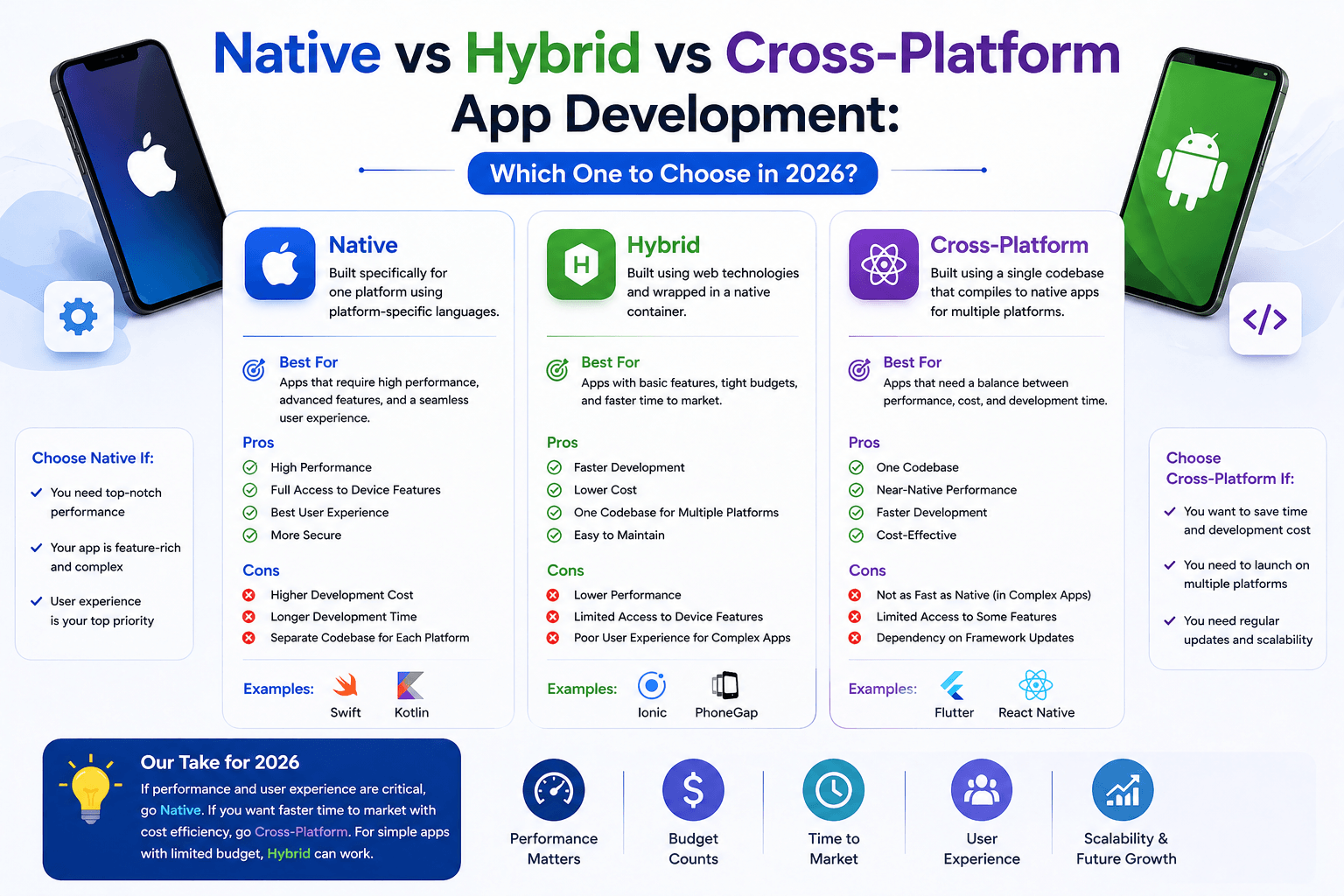
There are three primary approaches to building mobile apps in 2026:
- Native App Development - Built specifically for one platform (iOS or Android)
- Hybrid App Development - Web technologies wrapped in a native container
- Cross-Platform Development - Single codebase for both platforms (Flutter, React Native)
1. Native App Development
Native apps are built using platform-specific languages and tools.
iOS Native:
- Language: Swift or Objective-C
- IDE: Xcode
- Distribution: Apple App Store
Android Native:
- Language: Kotlin or Java
- IDE: Android Studio
- Distribution: Google Play Store
Pros of Native Development:
- ✅ Best performance and speed
- ✅ Full access to device features (camera, GPS, sensors)
- ✅ Better user experience (platform-specific UI/UX)
- ✅ Easier to optimize for app store rankings
Cons of Native Development:
- ❌ Higher cost (need two separate teams)
- ❌ Longer development time
- ❌ Separate codebases to maintain
2. Hybrid App Development
Hybrid apps use web technologies (HTML, CSS, JavaScript) wrapped in a native container like WebView.
Popular frameworks: Ionic, Cordova, PhoneGap
Pros of Hybrid Development:
- ✅ Lower cost than native
- ✅ Faster development
- ✅ Single codebase for both platforms
- ✅ Easy to find web developers
Cons of Hybrid Development:
- ❌ Slower performance than native
- ❌ Limited access to device features
- ❌ Less polished user experience
- ❌ Can feel "web-like" instead of "app-like"
3. Cross-Platform App Development
Cross-platform apps use frameworks that compile to native code for each platform.
Popular frameworks: Flutter (Google), React Native (Meta), .NET MAUI (Microsoft)
Pros of Cross-Platform Development:
- ✅ Near-native performance
- ✅ Single codebase for iOS and Android
- ✅ Lower cost than native
- ✅ Faster development than native
- ✅ Access to most native device features
- ✅ Growing community and support
- ✅ Hot reload for faster development
Cons of Cross-Platform Development:
- ❌ Slightly larger app size
- ❌ Some platform-specific features may need custom code
- ❌ Learning curve for new frameworks
Comparison Table
| Feature | Native | Hybrid | Cross-Platform |
|---|---|---|---|
| Performance | ⭐⭐⭐⭐⭐ | ⭐⭐⭐ | ⭐⭐⭐⭐ |
| Development Cost | ₹5-15 Lakhs | ₹2-4 Lakhs | ₹3-6 Lakhs |
| Development Time | 4-8 months | 2-3 months | 3-4 months |
| Code Maintenance | Two codebases | One codebase | One codebase |
| Device Feature Access | Full | Limited | Almost Full |
| Best For | High-performance apps, Games | Simple apps, Budget projects | Most business apps |
Which One Should You Choose in 2026?
Choose Native If:
- You need maximum performance (games, AR/VR apps)
- You have a large budget
- You only need to target one platform initially
- You need access to every device feature
Choose Hybrid If:
- You have a very tight budget (under ₹3 Lakhs)
- You need a simple app with basic features
- You need to launch quickly (under 2 months)
- You already have a web development team
Choose Cross-Platform If:
- You want the best of both worlds: good performance + lower cost
- You need to target both iOS and Android
- You want a single codebase to maintain
- You're building a typical business app (e-commerce, social, on-demand)
- This is what we recommend for most businesses in 2026!
What About Flutter vs React Native?
If you've decided on cross-platform, you still need to choose between Flutter and React Native:
- Flutter (Google): Better UI consistency, excellent performance, growing community
- React Native (Meta): Larger community, easier to find developers, mature ecosystem
Our recommendation: Both are great. Choose Flutter if UI/UX is your priority. Choose React Native if you want easier hiring and faster development.
Real Example from NSproWebtech
We recently helped a client launch a food delivery app. They had a budget of ₹5 Lakhs and needed both iOS and Android apps within 4 months.
Our recommendation: Flutter (cross-platform)
Result: We delivered both apps on time, within budget, with:
- Smooth performance (4.8 rating on both stores)
- Real-time order tracking
- Payment gateway integration
- Push notifications
- Admin dashboard
Our Recommendation for 2026
At NSproWebtech, we recommend Cross-Platform Development (Flutter/React Native) for most business apps. Why?
- ✅ 40-60% lower cost than native
- ✅ 50% faster development time
- ✅ Single codebase = easier maintenance
- ✅ Near-native performance
- ✅ Perfect for 90% of business use cases
App Development Cost at NSproWebtech
Here's a rough estimate of app development costs:
- Basic App (5-10 screens): ₹50,000 - ₹80,000
- Standard App (10-20 screens): ₹80,000 - ₹1,50,000
- Complex App (20+ screens): ₹1,50,000 - ₹4,00,000+
- Enterprise App: Custom quote
Note: These are estimates. Contact us for a precise quote based on your requirements.
Ready to Build Your App?
Not sure which approach is right for you? We offer free consultations to understand your business needs and recommend the best solution.
👉 Contact NSproWebtech today for a free consultation!
Frequently Asked Questions
How long does it take to build an app?
A basic app takes 2-3 months. Complex apps with many features take 4-6 months.
Do you publish apps on App Store and Play Store?
Yes, we handle the entire submission process for both stores.
Will I get the source code?
Yes, after full payment, you receive complete ownership of the source code.
Do you provide app maintenance?
Yes, we offer monthly maintenance packages starting from ₹5,000/month.